Day 49: W.H. Auden, Ryunosuke Akutagawa, Frederick C Crews
Ok, uni semester has finished and I am back at the challenge of trying to read 100 poems, stories and essays in a year.
Figure I will loosely follow an alphabetic structure this time. Today is A.
Poem - W.H. Auden - The More Loving One
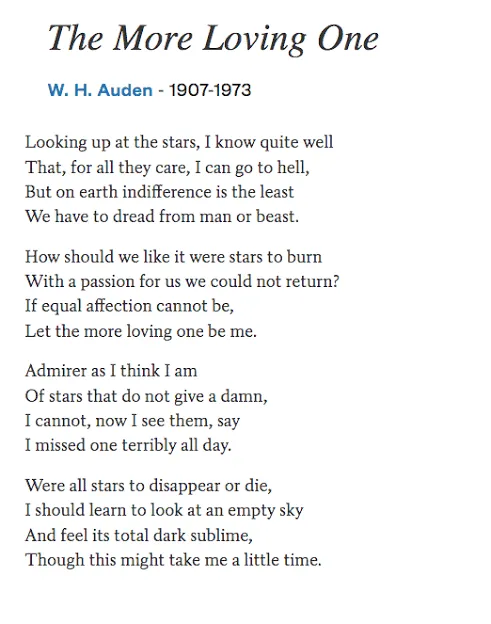
I bought a secondhand copy of Auden's selected poems, and from the 12 or so Ive read tonight, I havent really cared about his work. It seems so far to be dull frippery and witticisms. But I like this one. It is true that being the "loved one" is somewhat unbearable. As ambrose bierce said "theres no creature more affectionate than a wet dog".
Short story: Ryunosuke Akutagawa - Autumn Mountain
I found this story somewhat boring and overly convoluted with its many characters, but I like the story. It is a neat fable.
The narrator tells a story about a friend who had a master who once saw a beautiful painting who described it to the friend. The friend, 50 years later, still remembered the description of the painting and also fantasised about it. He tried to track it down and finally did and when he saw it he realised it wasn't as good as his master had made it sound. He wasn't sure if this was the original painting or a forgery. no one quite knows whether the original painting existed or was just a story of his master. But the narrator concludes that the painting was real because it existed in their minds.
"Well, in any case, the image of that strange painting is no doubt engraved forever on Yen-ko's mind. And on yours too."
"Yes," said Wang Shiku, " I still see the dark green of the mountain rock, as Yen-ko described it all those years ago. I can see the red leaves of the bushes as if the painting were before my eyes this very moment."
"So even if it never existed, there not really much cause for regret!"
The two men laughed and clapped their hands with delight.
I like that this story feels like a fable from a children's book, or a shaggy dog story whose convoluted names and framing devices lead to this fairly boneheaded phenomenological conclusion.
Essay: Frederick C Crews - The Consolations of Theosophy
I enjoyed reading this gossipy and exciting overview of the Theosophy movement and its strange preachers. It is a review for a 1996 book that I now cant wait to read, Madame Blavatsky's Baboon.
Part 2 of the very long article is less enjoyable. It tries to connect Theosophy to Nazism in a very roundabout and convoluted way. Then he quickly abandons the half-baked comparison and starts talking about Theosophy's occultish influence on Freudian and Jungian psychotherapy (which he hates). The article really seems to lose its point in this second part.
Furthermore, the author just comes to seem like an angry empiricist. Any mention of hypnotism or collective unconscious, there is a reminder to the reader that there is no scientific evidence for this. Sure, but boring.
I liked this bit:
"If occult concepts per se were psychologically noxious, we would expect Jungian ministrations in particular to wreak havoc on their clients, many of whom come away from therapy believing in fortune telling, mystical “synchronicity,” communion with pantheistic sources of wisdom, and similar willful notions. But those beliefs seem to render them only more cheerful, self-trusting, and tedious at parties."